
 English
 Bangla
 Arabic
What to Wear to an Indian Wedding When You Are Not Family
Attending an Indian wedding as a friend, a colleague or a plus-one is different from attending as family, and the difference is not about spending less. It is about calibration.
Family are participants. Guests are witnesses. The goal is to look genuinely well-dressed, to show that you took the invitation seriously, and to be entirely uncomplicated to look at.
The three rules that are not negotiable
1. Do not wear red to the ceremony
Red is the bride's colour in most Indian traditions, and appearing in it as a guest is a genuine misstep. This extends to bridal maroon and heavily bridal shades of pink. Wearing a red accent is fine. Wearing a red lehenga is not.
2. Do not wear white, and be careful with black
White carries mourning associations in most Indian communities, and it is not worn to a wedding. Black is treated as inauspicious by many families, though attitudes vary considerably and it is entirely accepted at receptions in many urban weddings. If you do not know the family well enough to ask, choose something else and remove the question.
3. Do not outdress the couple, and do not outdress the immediate family
A guest in a heavier, more elaborate outfit than the bride's sister is a guest who has misread the occasion. Dress well; do not dress to compete.
The safe register, function by function
Mehendi and haldi
You may not be invited to these at all as a non-family guest, and if you are, the register is relaxed. Light fabrics, bright colours, comfortable silhouettes. For haldi specifically, wear something you would not mourn, because turmeric stains permanently.
Sangeet
Festive and celebratory. This is the function where guests are given the most freedom, and where a well-chosen embellished outfit is entirely appropriate. Jewel tones, some shine, footwear you can dance in.
The ceremony
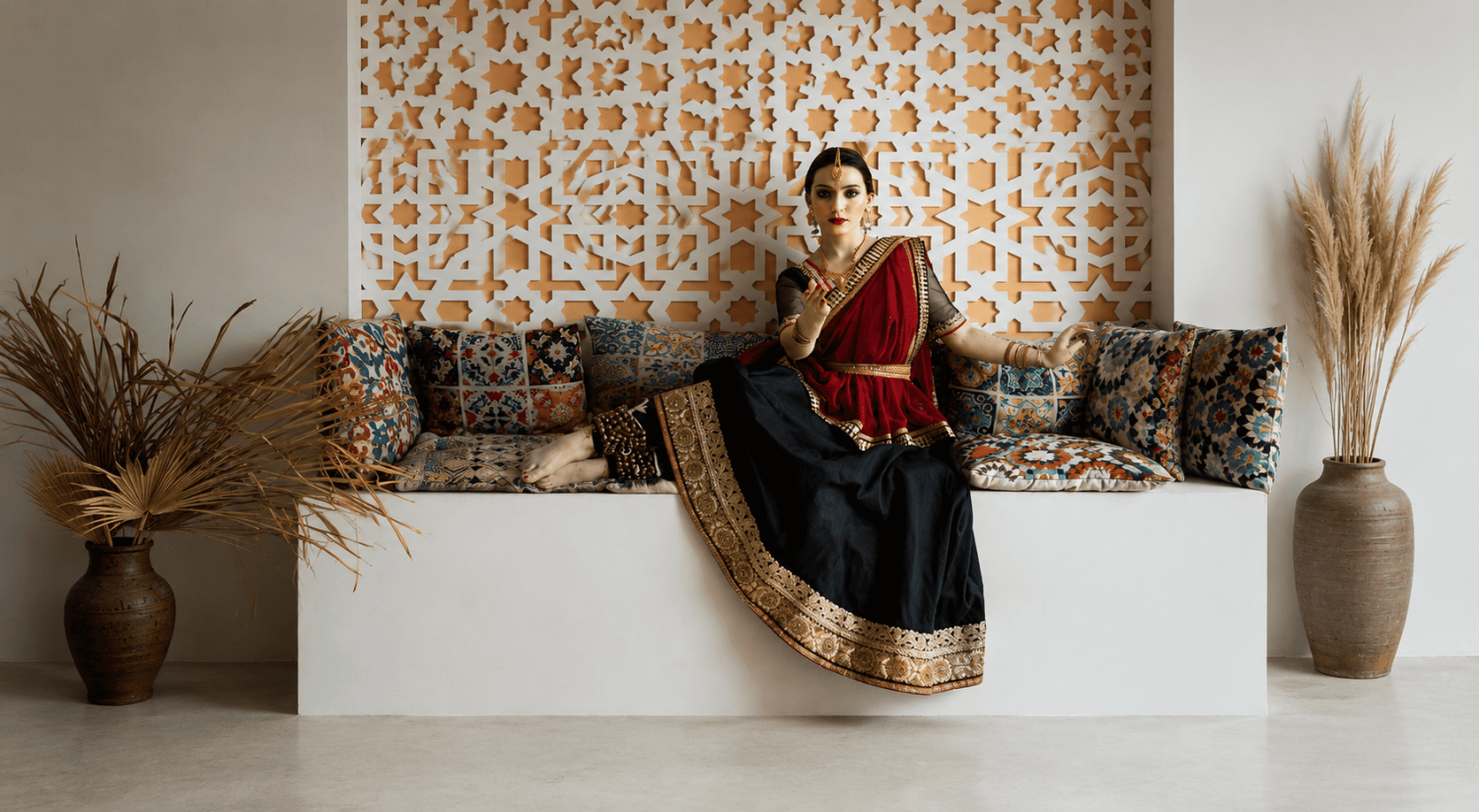
Traditional and formal. A silk saree, a good ethnic suit set, or a lehenga in a non-bridal colour. For men, a kurta set or a bandhgala.
Ceremonies are frequently long, often held at difficult hours, and often involve sitting on the floor. Dress for the reality, not for the photograph.
Reception
The most formal and the most flexible. Both Indian and western formal wear are usually acceptable. Gowns, formal sarees, lehengas, well-cut suits.
Colours that are always safe
Emerald and bottle green, royal blue and navy, teal, plum and aubergine, mustard and ochre, dusty rose and mauve, silver and grey, and ivory paired with a strong accent colour. All read as festive, none competes with the bride, and all photograph well under both daylight and artificial light.
For men
The bar is lower and the failures are more common. A well-fitted kurta with a Nehru jacket covers almost every function. A bandhgala or a suit covers the reception. The two things men most often get wrong are footwear and fit: formal Oxford shoes with a kurta look wrong, and a kurta that does not fit at the shoulder cannot be rescued by anything else.
Practical matters
- Ask about the dress code. A single message to whoever invited you resolves every ambiguity above. It is neither rude nor unusual, and it is what considerate guests do.
- Check whether functions are indoor or outdoor, because a December outdoor ceremony in North India is genuinely cold and an unplanned guest will be visibly uncomfortable.
- Wear shoes you can remove easily. Many ceremonies are held in spaces where footwear comes off.
- Carry a small bag. A large tote at a wedding is an inconvenience you will regret carrying for six hours.
- Do not wear a new outfit for the first time to the wedding. A garment you have never worn will reveal its problems at exactly the wrong moment.
The underlying principle
The best-dressed guest at a wedding is the one who is remembered as having looked wonderful and who nobody had to think about while they were there. Aim for that.
Related reading
Recent Posts

Home Improvement Meets Festive: Small Decor Upgrades Before the Guests Arrive
Your First Order on Seoul Street: Payment, Shipping, Tracking and Returns
Reading a Product Page Properly: Fabric, Fit, Lining and What Is Included